
The Land Incanted
GHOST SHELLS
The Cabrach, Aberdeenshire 2024
The years have seen unremitting decline. In 1831 the population of the parish was 978; by 1901 it had dropped to 581. At the turn of the century it was reported that nearly 100 dwelling houses in the valley of the Deveron were in ruins, while to the south in the neighbourhood of Bridgend and Aldivalloch, the creeping rot of depopulation was spreading.
excerpted from Land of the Lost, exploring the vanished townships of Scotland, Robert Smith, 1997
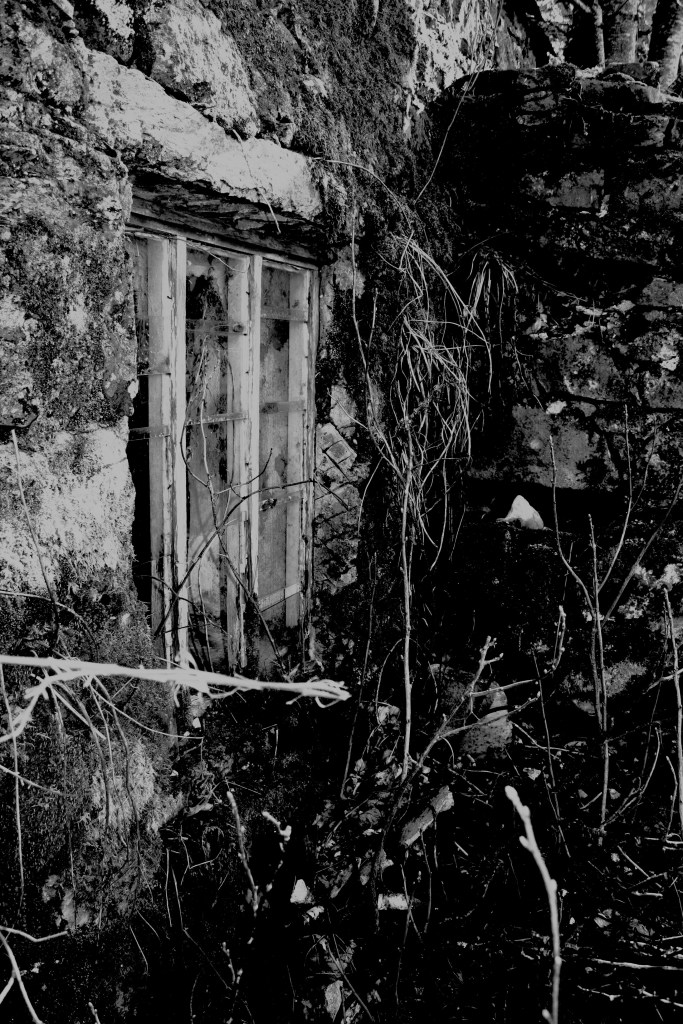
You find them scattered across the country, wrapped in hollows, or narrow waists of land, amongst clusters of wild grass, nettles, dock, colonies of gorse, or the weed-stricken margins of unfarmed fields – barely visible, with no obvious approach roads or rough tracks, they are quietly set adrift like nameless islands. Human presence is hardly discernible in some places, the surrounding land having been parcelled off, forgotten, blurred, folded inwards. Wrapped in waste. Sometimes all that remains is barely a tumble of stones, nothing that could ever resemble any kind of building – perhaps more akin to the ancient cairns which also punctuate the land.
Markers. Symbols.
Other buildings are recognisable as sites of human habitation, yet they lack the aura of the hospitable. They sit lifeless and inert. Lost in time. Something of them draws my eye – captures my imagination – though trying to quantify that leaves me conflicted. I came first to look, to gain some sense of how things once were. To try and piece them together stone by stone, story by story – notebook and camera in hand. A kind of salvage – a humble and humbling testimony. When I immerse myself further in this place, and slowly elide with the land and its unwritten song, its uncertain future – I begin to wonder if I can attempt to reclaim a half-imagined past from the material at hand? Could I construct a narrative from such slender threads?
There is barely a journey to be had in Scotland where you are not confronted by some ruinous croft, shieling, blackhouse, farmstead or dwelling of some description. They litter the landscape, poignant reminders of what once was. Memento Mori
Communities of workers, villages, farms and clachans have passed over into the fading mists of unwritten history, and the shattered remnants of once solid dwellings, are now reduced to relict silence. Since the time of the Clearances, through to the war years, the glens and straths have succumbed to the encroaching threat of modernity, the lure of the big cities with all that they offer, and the harsh, unforgiving weather that makes life and work largely untenable in these remote outposts.
The Cabrach, an area sitting roughly north-west of the city of Aberdeen, has more than its share of ruined buildings, concentrated into an area some 208km square, its history at first glance appears blighted with loss. Tenanted largely by cottars (farm labourers) or crofters, many of the older buildings erected here are little more than haphazard arrangements of stones, a couple of chaotic courses of crumbling masonry are all that remain – though they were little more than that when they were inhabited.
The vernacular for the area usually conformed to the old ‘but and ben’ model, similar in style to the Blackhouses of the outlying islands, that had barely two rooms, divided by a wall or partition that marginally separated occupants from livestock. They were largely poverty-stricken folk, peasant types whose lives and toil were unspeakably harsh. The priests in the nearby area of Shenval in Lower Cabrach wryly referred to the area as ‘the Siberia of Scotland’.
Further up the social scale were the hinds (ploughmen) herds, threshers and crofters whose accommodation was very often incorporated into the farm area. The crofters were marginally better off than the cottars, and tenancy or joint tenancy of a farm was held directly by the tackman or landowner.
The blight of hunger and poverty eventually drove the people from these ‘lost’ communities. In the “ill years” of the late 18th century, famine spread like a wild fire, killing more than half the population, and the bitter frosts ravaged crops in the area so badly that some were forced to eat mugwort, nettles and turnip thinnings. A 19th century traveller, J G Phillips, author of Wanderings in the Highlands , came into The Cabrach from Glenlivet via the Steplar Trail and wrote about ‘rents of rain’ and “a mist that shut out hill and glen, rock and stream, earth and sky. All around was dim semi-darkness…” This was known as ‘black weet’ . There was also ‘white weet’- snow. It was once said that it ‘dang doon black weet’ for six weeks in The Cabrach. Phillips depicted it as – “a barren desert where no creature lived” For those forced to eke out an existence here, the future was precarious.
Over time, the landowners and lairds became the instigators of the gradual eviction of destitute tenants from their properties. Not as severe as the Clearances, this was nevertheless a slow, prolonged process of dispossession. Evictions, famine, crop failures caused by foul weather, and subsequently, recruitment into wartime service in the army were the agents that led to the steady erosion of population in the glens, and economic decline became an inevitability.
My frequent and continuing visits to The Cabrach have revealed layers of meaning I had not previously thought possible. In these places of absence, erasure and loss, it would be too easy to be consumed with melancholy. For those that still live here especially, they are confronted with the physical evidence daily – the ghost shells of dwellings and work places remaindered in the land, as well as the anecdotal evidence serve as constant reminders. For some, whose familial lineage reaches back to those difficult times, recalling that past is easier, yet more painful. They feel the weight of their personal history, and those fearsomely challenging times. It courses through their blood and their memory like a virus.
A place should not carry with it the burdens of its past – memories are difficult to erase, but they can be overwritten, the narrative can be changed. As an itinerant Englishman newly settled in this area, I feel an additional burden, as for some, I would have no right to comment on the history of a place and a people unfamiliar to me. We do not share the same blood, nor the same social memory. Up here we are known (rather pejoratively) as “blow-ins” , which might suggest that some of us may only be passing through, and recently arrived, have only a cursory interest in the places we find ourselves inhabiting. However, this part of North East Scotland is possessed with a spirit and history that is impossible for me to ignore. I feel and sense it deeply, it ignites my imagination, and I am compelled to draw upon its magic as a source of inspiration for my art. My challenge is doubled as I have to respect the history of the place, yet somehow there is a need to create a fresh perspective – overwrite or superimpose the new over the old – create a new mythology, an act of re-enchantment. How to inscribe a fresh narrative without destroying that which already exists?
“ Tradition is not in the worship of ashes, but the preservation of fire..” – Gustav Mahler
In an old village, known as Horseward, up on the BlackWater in the Cabrach’s “Siberia”, a whole community was erased from the maps. The village adopted its name from an ancient custom of turning horses onto common hill pasture during the summer months. More than a century ago the village was deserted and there remains no physical record of its existence, nothing that shows it was ever there – it lies beneath the soil, obliterated, forgotten, ploughed under. Its story reduced to the merest of whispers. Nearby, close to the banks of the Deveron there were found a number of ancient stone kists containing bones and an urn, possibly dating back to the mesolithic period, and very recently an illicit whisky still was found partly buried out in the hills at Blackmiddens, one of many that yet remain to be found. All of these layers of the region’s history combine and elide deep within the earth, and I have little doubt, based upon these findings, that The Cabrach, like many other places, has more secrets still to be revealed. Although to my knowledge, no extensive programme of archaeological excavation has been undertaken here, something of its deeper past may yet emerge from the darkness.
How does the history of the land manifest itself? How can those voices from the distant past be heard, echoing out of the silence? The Cabrach is itself a vast, complex archive of people, places, events and artefacts, all in a state of continual metamorphosis – captured in a mesh of relationships that constantly write and re-write themselves, evolving and involving, with some evaporating into non-existence. From mountain to burn, farmstead to moorland, heather to gorse, the land itself is in flux, as successions of plant species seed the soil – and as they decay, form the ancient, layered peat we find beneath us. Every kirk, and bridge, every shieling and thackit house is caught in the net of transformation, as materials are harvested or quarried, incorporated into buildings, and subsequently re-absorbed into other forms of utility – walls, pathways – broken up to form the footings of new structures, or reincorporated back into the soil. A return to origins. Everything here is in motion – everything, a constant vibration.
It is because of this emphatic and overwhelming sense of loss, absence, and the unspoken or unrecorded history of this place that I turn to words, language, as a means of excavating the past, and revivifying that which has become lost in the entanglements of place and landscape, consigned to the margins. The words “incant” and “enchant” have a similar etymology – to bring into being – to influence or attract, with words or song.
A summoning, an invocation.
The task is almost impossible, even futile, yet to remain silent is equally useless and counterintuitive. The loss then would be of my own making, a tragedy on every level. My own recourse is to salvage something from the remembered earth – from artefacts, remnants, ruins, and vestigial resonances, things dredged up from this archive of disappearances – I will bring them into the light, endow them with fresh life, and – if only for a brief time, attempt to give voice to the land.
I collect from the places I have visited – natural litter, discarded bones, husks and shells, leaf skeletons, seed pods, decaying wood, rusty keys and hinges, pebbles from the river’s edge, dead insects, tangles of wire, assemblages of nameless detritus retrieved from an abandoned homestead – physical mnemonics, spells, invocations.. a quiet alchemy of remains and vestiges, collectively they will form a picture, conjured from the shadows and the silence – memory is condensed – folded into them, each will tell its story, .. each will find its path.. an act of divination, freeing the land from its enforced amnesia.
3rd Draft, OCTOBER 2024
“The doctor by nature was a very stout built man, and a great pedestrian. On his first approach to Cabrach he preferred walking across the hills from Rhynie. On reaching the summit of the hill and looking down on the valley below he observed a river winding its serpentine course along its midst ; this river had the appearance to emerge out from below a mountain to the west, and to disappear below a mountain in the east, there was no appearance of an ingress or egress, its banks were decked in green sward where black cattle grazed in abundance, and its heath-clad braes covered with fleecy flocks..”
Taken from ‘The Cabrach Feerings’, Taylor, 1948
 The Land Incanted [ Earth & Memory ]